
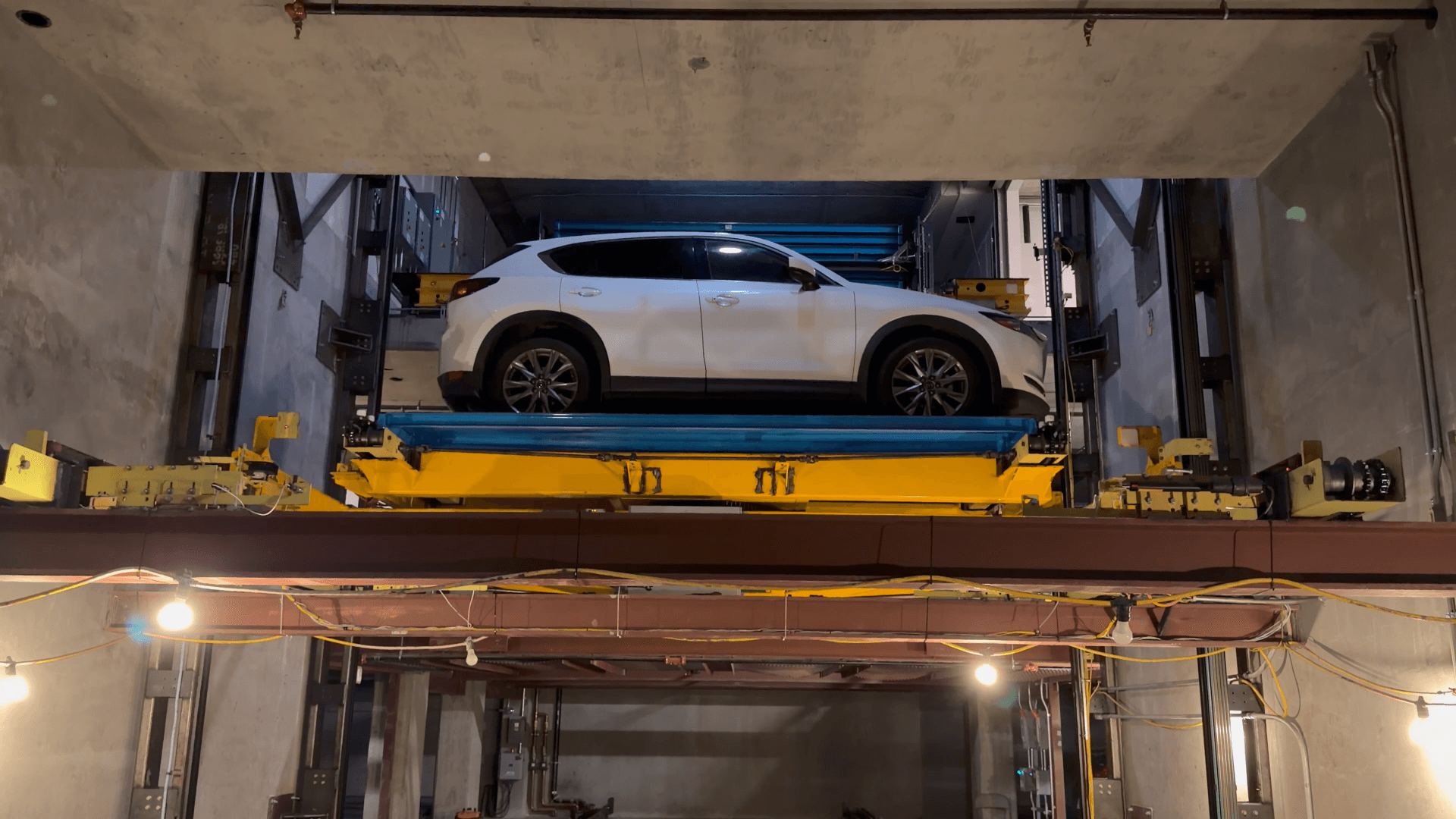
One such system, AUTOParkit, operates without robots. Instead, it relies on a rack-and-rail design paired with programmable logic controllers (PLCs). This distinction, while subtle at first glance, reflects a larger debate about what level of engineering precision is actually necessary for storing vehicles inside a building.
Machine Tolerance vs. Building Tolerance
Robotic controls are typically deployed in applications that demand extreme precision, often measured in millimeters. Examples include surgical robotics, robotic welding, and assembly lines where machines pick components from moving conveyors. In these contexts, a tolerance of just one millimeter (roughly 0.04 inches) can make the difference between success and failure.
Buildings, however, are far less exact. Concrete slabs, for instance, are permitted height variations of half an inch across 20 linear feet—sometimes more. Structural deflection under live load can alter a slab’s flatness by several inches. On top of that, skyscrapers are engineered to sway multiple feet in high winds, while steel and concrete expand and contract with changes in temperature, sun exposure, and weather.
These realities present a fundamental challenge for robotic control: if a system is designed around millimeter-level tolerances, the natural movement of a building can push it out of alignment. For automated parking, where vehicles weighing several thousand pounds must be positioned safely and reliably, building-scale tolerances in the range of inches—not millimeters—are far more practical.
Cost and Complexity
Another factor shaping system design is cost. Robotic platforms typically use DC brushless motors paired with servo drives to deliver the precision required. But these components are expensive—often more than twice or up to 10x the cost of equivalent AC motors—and are typically cost-effective only in low-power applications. Moving a 6,000-pound vehicle requires significantly more power. AUTOParkit, for example, relies on AC motors ranging from 3 to 50 horsepower, keeping overall system costs lower.
The control architecture also diverges sharply from robotics. AUTOParkit’s reliance on PLCs—ubiquitous in industrial automation—means maintenance can be performed by engineers already familiar with widely available off-the-shelf components from manufacturers like Siemens. By contrast, robotic systems demand specialized knowledge that can raise costs over the long term.

Robot (AGV) Underneath Vehicle Guided by Bar Codes Embedded Into the Concrete Floor
Linear Movement vs. Robotic Control
At first glance, an AUTOParkit facility may appear “robotic.” Vehicles move seamlessly in and out of storage as multiple subsystems operate simultaneously. But the underlying mechanics are simpler: each subsystem handles a single axis of movement at a time, relying on straightforward point-to-point motion.
In robotics, true multi-axis coordination is required to execute complex curved paths. By comparison, automated parking only demands simple linear motions—moving cars forward, backward, sideways, or rotating them when necessary. The most complex operation AUTOParkit performs is turning a vehicle 180 degrees.
AUTOParkit Pallet-Based Rack & Rail System – No Robotics, Hydraulics, Pneumatics
(NO FLOORS REQUIRED)
Rethinking the Label
The distinction between robotic and automated parking isn’t just semantic. It highlights a broader engineering principle: technology should match the tolerances of the environment it operates in. Parking cars requires building-scale adaptability, not the millimeter precision of surgical robotics.
For developers, that translates into lower costs, simpler maintenance, and a system better suited to the realities of concrete, steel, and weather. In this light, the popular shorthand of “robotic parking” obscures more than it explains.
For more information, see www.AUTOChargit.com or contact Shawn Adams at:
sadams@dasherlawless.com
M 630.310.1902